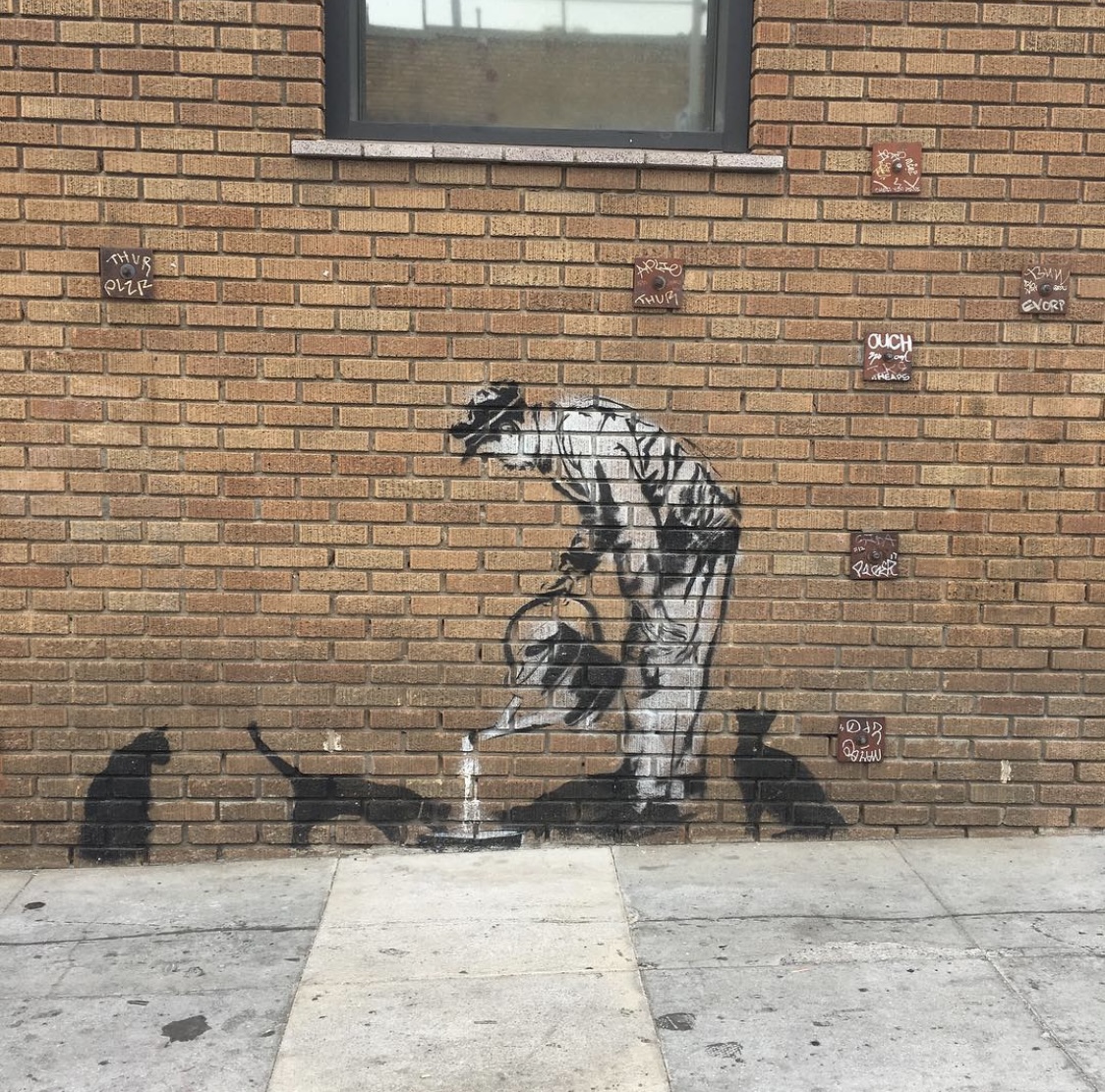
Making sure the stray cats stay watered.
Abbot Kinney, Venice CA.
I have a picture I took on Abbot Kinney in Venice, California.
I took it in 2020. He had a residency there in 2011 — a stretch of weeks when the city woke up each morning not knowing what wall had changed overnight. The piece shows a figure bent at the waist, pouring water from a watering can. Stray cats gathering at his feet.
Nine years later it was still there. Make of that what you will.
A major wire service published an investigation last month. A handwritten confession from a 2000 arrest in New York. Court records. Photographs from people who knew him back then. The evidence, they say, is beyond dispute. They named him.
I won’t be doing that here.
It would take you thirty seconds to find it — which is exactly the problem. We live inside a machine built to eliminate not-knowing, and we’ve developed the reflex of reaching for every answer before we’ve decided whether we actually want it. The name is out there. That doesn’t mean you need it.
His lawyer made the serious case: anonymity protects artists who speak truth to power from retaliation, censorship, the various ways institutions push back when you embarrass them on their own walls. All true. But there’s a simpler case worth making alongside it.
Some things are better when you don’t know who made them.
Think about what Batman actually is — not the movies, the idea. A symbol that works precisely because it doesn’t belong to one person. Unmask him and you have a billionaire with unresolved childhood issues. Leave the mask on and you have something the city made from its own fear. Everyone who needs him gets to have him.
That’s what anonymity does at its best. A rat stenciled on a government wall means something different when it comes from nowhere — from the general frustration of everyone who’s ever felt like the institution wasn’t built for them. Put a face on it and it’s one guy’s editorial. Leave it faceless and it’s yours.
Elena Ferrante has written some of the most celebrated novels of this century without confirming who she is. Her position is simple: the work should stand on its own. When a journalist tried to identify her through financial records a few years back, the literary world largely called it what it was — an intrusion, not a scoop.
Daft Punk played the Grammys in helmets. Accepted their awards in helmets. Retired in helmets. Two men from Paris who understood that the music lands differently when you can’t put a face to it.
B. Traven wrote The Treasure of the Sierra Madre and refused to be identified his entire life. Died in 1969. Still nobody knows for certain who he was. The novel is still standing. It exists on its own terms because it had to — and it’s better for it.
Satoshi Nakamoto published the Bitcoin white paper, built the foundation of an entire financial system, and walked away completely in 2010. Multiple investigations. No confirmed identity. The work kept going without him because the work was always the point.
And then there’s Vivian Maier — a nanny who made over 100,000 photographs and showed almost none of them to anyone. Found after her death when a box of negatives sold at auction. She wasn’t hiding. She was just private. The work existed without an audience for decades and lost nothing in the waiting.
There’s a grave in Arlington with no name on it because the name would ruin it. The Unknown Soldier works because he belongs to everyone. Give him a name and he belongs to one family. Leave it blank and every family gets to stand there.
We don’t build things that way much anymore.
Back to the photograph.
The figure still pouring water. The cats still gathering. Pest Control never confirmed it — maybe it isn’t his. Maybe someone who’d spent long enough looking at his work made something in that register and left it there on a Venice wall. Maybe the question of whether it’s real is doing more work than a certificate of authenticity ever could.
Three strangers stopped that Tuesday afternoon and said nothing to each other and left still thinking. That’s all the authentication anything ever needs.
A wire service named him last month. Thirty seconds and you’ll have it. I’ve written this whole piece without using it and I’m asking you to sit with that for a second before you go looking.
Because here’s the thing.
New walls keep going up. New cities. Pieces so well-timed they feel like tomorrow’s newspaper printed last night. Whoever he is, whatever name he’s going by now, he keeps showing up.
Maybe we’re the stray cats. And he keeps making sure we’re watered.
That’s enough. That’s more than enough.