Brian Donnelly grew up in Jersey City staring out a classroom window at a building roof he’d tagged with his own name. He called himself KAWS — street phonetic of Cause. He chose the letters because he liked how they fit together. That’s a very specific kind of mind — one that thinks in shapes before it thinks in language. He went on to study illustration at the School of Visual Arts in New York, graduate in 1996, and spend his evenings breaking into bus shelters with a skeleton key gifted by a friend.
By day he was painting animation backgrounds for Disney. 101 Dalmatians, Daria, Doug. The cartoons were the day job and the streets were the work — two tracks running parallel that would eventually collide into something neither world could fully claim. At night he was breaking into bus shelters with a skeleton key, painting over Calvin Klein ads in his own hand, then replacing the ads exactly as he’d found them. For a long time, nobody stopped. Nobody looked twice. The altered CK One poster looked like a poster. The style hadn’t announced itself yet. People walked past it on their way somewhere else.
Then, slowly, it did. The work accumulated. The hand became recognizable on its own terms — and once you could see it, you couldn’t stop seeing it. Which is when the posters started disappearing from the shelters before the ad companies could replace them. The audience found the work before the galleries did. That’s the arc of any serious visual voice: it precedes its own recognition. Something placed in public space, waiting. Not for everyone. For whoever’s already looking.
The Companion came first — a grayscale figure, clown-like, loosely structured around the outline of Mickey Mouse, face buried in both hands, twin bones protruding from its skull. It arrived as a vinyl toy in 1999, produced in Japan. Small enough to hold. Specific enough to haunt. The X-ed out eyes became the signature. A kind of mark — part grief, part cartoon, part something that lives in between the two and refuses to resolve. The work that followed scaled that figure up. Ten meters of painted fiberglass in galleries in Switzerland, Hong Kong, London, Taiwan. A 115-foot inflatable floating in Victoria Harbour for Art Basel Hong Kong in 2019. A balloon in the 2012 Macy’s Thanksgiving Day Parade. The Companion moved from pocket to harbor. The idea stayed the same.
None of this made him legible to the gallery world right away. It made him legible to the people who had grown up inside the same visual culture he was reworking — the skateboard decks, the cartoons, the streetwear, the toys. The collectors who showed up at his drops weren’t wearing suits. By the time the suits arrived, the work was already at auction for $14.8 million.
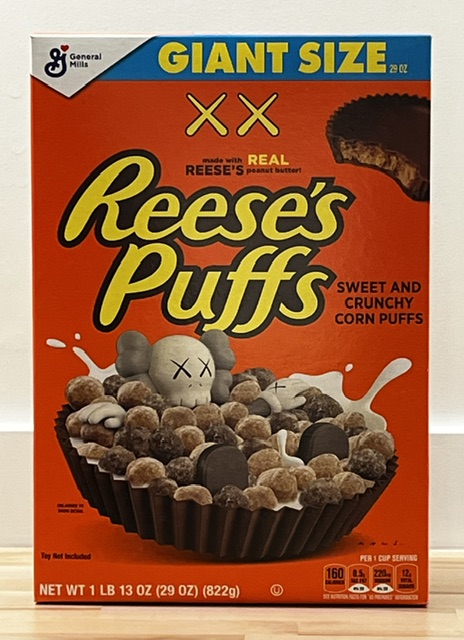
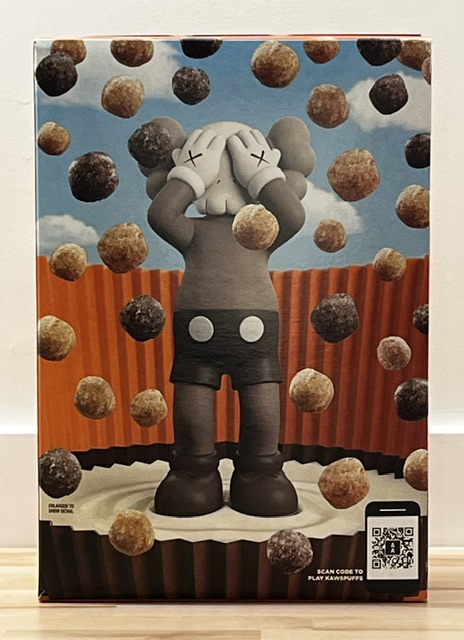
In 2021, KAWS did his first cereal collaboration. Reese’s Puffs. Two limited-edition boxes — one in the brand’s signature orange, one in a blue that Reese’s had never printed before. The Companion, who had floated above Hong Kong harbor, was now bathing in a pool of chocolate peanut butter cereal. The AR game that came with it put the Companion in a bowl of falling Puffs and ended when you missed three. When you lost, the Companion sank into the milk. That’s either deeply absurd or kind of perfect. Probably both.
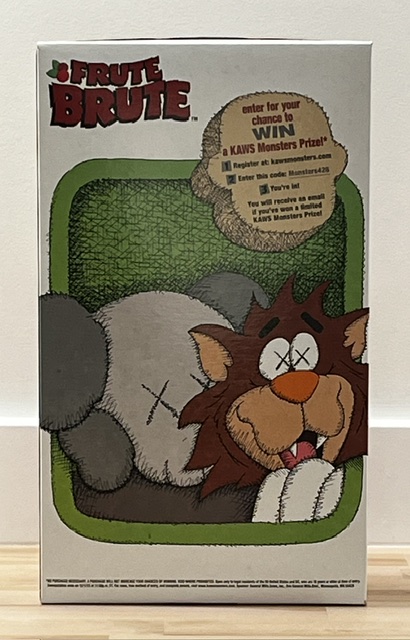
The Monster Cereals were 2022. Count Chocula, Franken Berry, Boo Berry, and — back from a nearly decade-long absence — Frute Brute. KAWS had been a fan since childhood. That part matters. He wasn’t hired as a designer to execute a brief. He was a kid who grew up eating these cereals, who had spent thirty years building a visual language, and who finally got to put that language on boxes he remembered from his own childhood kitchen. The designs riffed on the vintage originals — same compositions, same monsters — but the linework was his. The X-ed out eyes were everywhere. Four boxes, one for each monster, and on the back of each a code you could enter for a chance at a set of collectible figures.
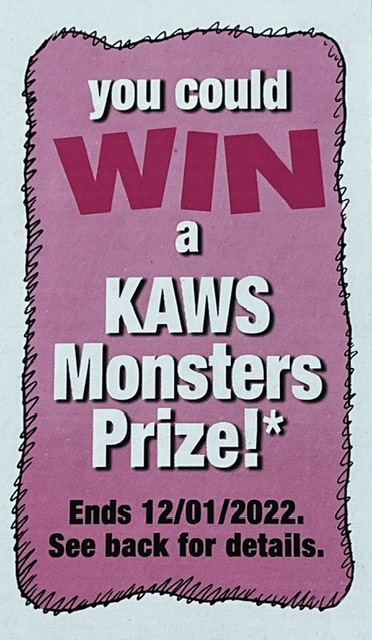
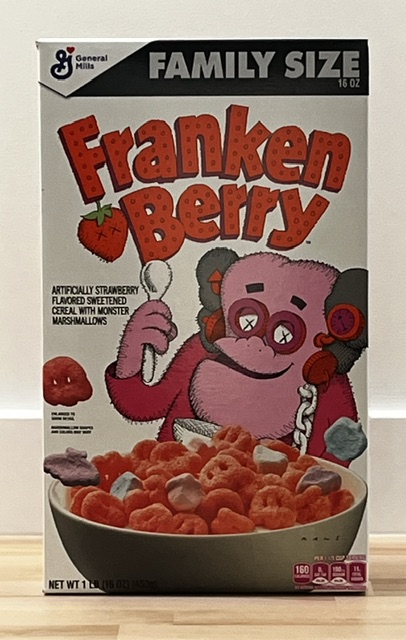
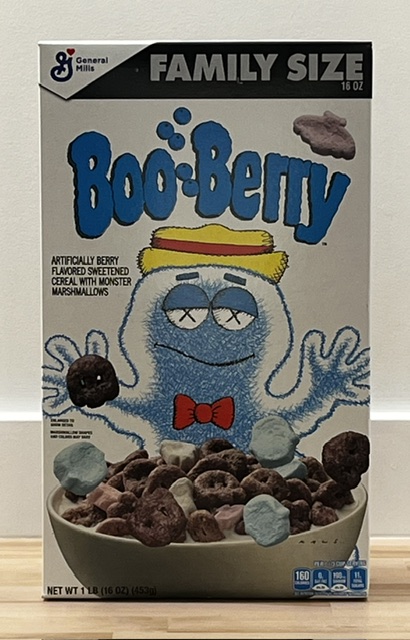
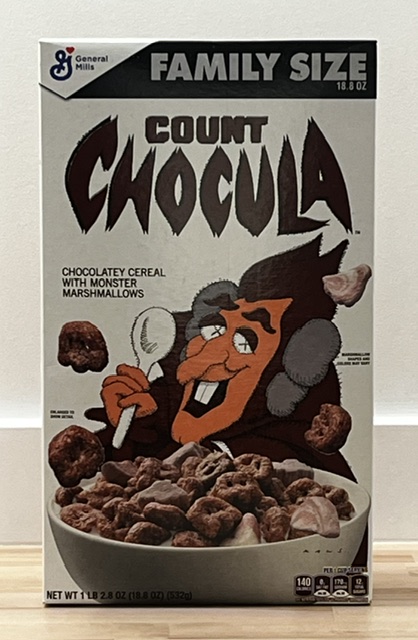
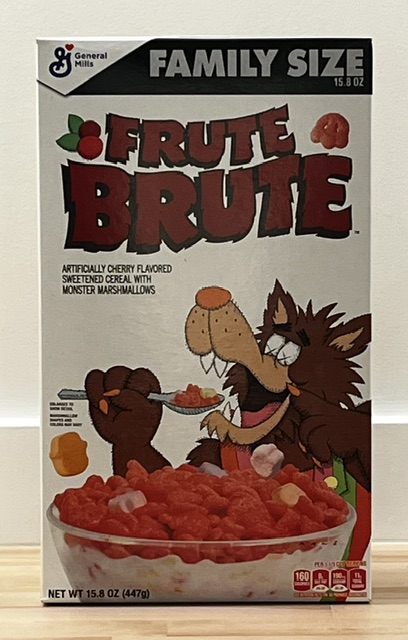
I got the full set of boxes.
Not from a sweepstakes. I found them, bought them, kept them sealed. The boxes live on a shelf. There was something about the moment — a serious artist, a blue-chip name with work in permanent museum collections, applying that same hand to General Mills cereal boxes — that felt specific and unrepeatable. The kind of thing that’s everywhere for about six weeks and then disappears into landfill or a child’s hand. The kind of thing that becomes rare not because anyone decided to make it rare, but because time just works that way. Cardboard doesn’t last. Most of what was made is already gone.
I recognized it for what it was. I bought a complete set and put it somewhere safe.